April 4, 1850 – Los Angeles, California is incorporated as a city.
Los Angeles City Hall, completed 1928, is the tallest base isolated structure in the world. It is the center of the government of the city of Los Angeles, California. It houses the mayor's office as well as the meeting chambers of the Los Angeles City Council. It is located in the Civic Center district of Downtown Los Angeles in the city block bordered by Main, Temple, 1st, and Spring streets.
History
The building was designed by John Parkinson, John C. Austin, and Albert C. Martin, Sr., and was completed in 1928. It has 32 floors and, at 454 feet (138 m) high, is the tallest base-isolated structure in the world, having undergone a seismic retrofit that will allow the building to sustain minimal damage and remain functional after a magnitude 8.2 earthquake. The concrete in its tower was made with sand from each of California's 58 counties and water from its 21 historical missions. The city hall's distinctive tower was based on the purported shape of the Mausoleum of Maussollos, and shows the influence of the Los Angeles Public Library, completed soon before the City Hall was started. An image of City Hall has been on Los Angeles Police Department badges since 1940.
Due in part to seismic concerns, prior to the late 1950s the City of Los Angeles did not permit any portion of any building other than a purely decorative tower to be more than 150 feet (46 m) high. Therefore, from its completion in 1928 until 1964, the City Hall was the tallest building in Los Angeles, and shared the skyline with only a few structures having decorative towers, including the Richfield Tower and the Eastern Columbia Building.
The building was designated a Los Angeles Historic-Cultural Monument in 1976.
Usage
An observation level is open to the public on the 27th floor. The Mayor of Los Angeles has an office in room 300 of this building and every Tuesday, Wednesday and Fridays at 10:00am, the Los Angeles City Council meets in their chambers. City Hall and the adjacent federal, state, and county buildings are served by the Civic Center station on the Metro Red Line.
Popular culture
The building has been featured in the following popular movies and television shows:
Adventures of Superman - as the Daily Planet building beginning in the second season of the 1950s TV series. At the time the TV program was broadcast, the show's "Daily Planet" building (Los Angeles City Hall) was frequently confused with the similarly designed Pennsylvania Power & Light Building in Allentown, also built in 1928. Additionally, the exact design of this building is used as the Newstime magazine headquarters in the Superman comic books.
Alias - a CIA black ops unit is located behind a maintenance door at Civic Station.
Dragnet - the building appears as itself in the TV series. The first episode of Dragnet (1951) Season 1, Episode 1: "The Human Bomb," Original Air Date: 16 December 1951 was filmed at Los Angeles City Hall. It was embossed on Sgt. Joe Friday's famous badge number 714 that was displayed under the credits.
Adam-12 - During the Seventh Season opening credits montage, City Hall is shown directly at the end, as the building that officers Reed, and Malloy drive away from, it is also shown on the embossed badges, numbered 744 (Malloy), and 2430 (Reed).
The 2003 Dragnet series - used the L.A. City Hall building aerial shot and badge throughout its introduction.
War of the Worlds - the City Hall was destroyed in the 1953 film version (although the H.G. Wells book has the aliens attacking London, the setting was changed to Los Angeles for the film).
and also in the following other media:
Midnight Club: Los Angeles video game as part of Downtown Los Angeles of the city of Los Angeles.
Mission impossible :"Ultimatum" 1972 Thermonuclear bomb planted under City hall in sewer duct by frustrated nuclear scientist, in order to blackmail the US government into "change" of its foreign policy and replacing some "corrupt" congress and cabinet members. If demands are not met..the 50MT bomb will detonate--destroying all of Los Angeles county. The IMF must locate and defuse the bomb before it is too late.
GTA:San Andreas video game as part of the city of Los Santos.
Mobile Suit Gundam: The Origin (Japanese manga series) - the building serves as the headquarters for one of the main occupation armies of the antagonist Principality of Zeon, under Garma Zabi.
Miss Murder, music video by the band AFI (April 2006)
Escape From L.A.- The building is shown sunken, along with the ruins of Los Angeles, as Snake
Plissken operates his submarine toward the prison.
SWAT 3 - One mission has the player rescuing hostages and defusing a bomb within the top floors of the building.
Showing posts with label city government. Show all posts
Saturday, April 2, 2011
Saturday, March 19, 2011
Celebrity Grave: Founder of Hollywood Harvey Wilcox 1891
Harvey Henderson Wilcox (1832 - March 19, 1891) owned a ranch to the west of the city of Los Angeles, which his wife Daeida named their ranch Hollywood, and where the center of the American cinema industry developed in the early 1900s. She learned of the name from Ivar Weid her neighbor. Ivar Weid heard the name from HJ Whitley.
Biography
Harvey Henderson Wilcox was born in New York State, probably in Monroe or Ontario County, the son of Aaron and Azubah (Mark) Wilcox. The family moved to Michigan during the 1830s and Harvey was raised on his parents' farm in Ogden Township, Lenawee County, Michigan. He was stricken with polio in 1845 when he was about 13 years old and confined to a wheelchair the rest of his life. Whether in a wheelchair or not, Harvey accomplished great things during his lifetime, a testament to the Wilcox strength and spirit. He is described as being a Kansas Prohibitionist in histories written after his death, but that tells only a small, insignificant part of his story and there is no original source stating with any certainty that he actually was a prohibitionist.
In September 1850 Harvey was described as being an apprentice shoemaker in the Horace Sheldon household in Blissfield, Lenawee County. His apprenticeship was probably because he could not work on the farm due to his handicap. He completed his apprenticeship during the 1850s and in 1860 he was living near Edgerton, St. Joseph Township, Williams County, Ohio, and working as a shoemaker. On December 26, 1861, he married Ellen E. Young in Bryan, Williams County, Ohio. He got into politics in Williams County and ran for, and was elected to, several local offices, including County Recorder in 1860, Justice of the Peace (Magistrate) in 1860, and Notary Public for Williams County in 1866.
He also gave up shoemaking to deal in real estate in Bryan in the firm of Wilcox & Langel, a career that he would follow the rest of his life. Coincidently, Elon Langel later moved to Topeka, Kansas and died there of tuberculosis.
The local Bryan newspaper says in April 1868 that Harvey and Ellen Wilcox were moving to Topeka, Kansas where, in October, 1869, Harvey published "H.H. Wilcox's Real Estate Publisher" and in July 1870 he was described as a real estate agent and his wife a housekeeper. Before March 1875 they had added G.M. Stanley, the son of Ellen's sister, Alvira, to their family, but they never had any children of their own. In June 1880 Harvey was still in real estate and Ellen was running their boarding house on Kansas Avenue.
Harvey must have enjoyed being in politics in Bryan because in Topeka he got into politics again, serving as president of the city council for at least one term in 1870; joined several other men to found the town of Rossville, Kansas, in 1871; served as Topeka city clerk from at least 1877 through 1880; and owned a ranch and relatively large herd of cattle (that his adopted son, George M. Stanley, managed) near El Dorado in Butler County, Kansas.
Harvey and Ellen were in the 1880 census of Topeka with George M. Stanley, the son of Ellen's sister, Alvira Stanley, in their household. Ellen contracted tuberculosis and spent the winter of 1881-1882 in California, probably staying with her sister, Mary Jane (Young) Bond in Santa Barbara, "chasing the cure." Ellen returned to Topeka, uncured, in early 1882. She was kept alive on the train with "powerful stimulants" and died at the age of 37 soon after her arrival home. She is buried in Topeka Cemetery.
Harvey married as his second wife, Daeida "Ida" Hartell, a girl more than thirty years his junior, on December 6, 1882, in Topeka and in October 1883 it was reported that "Harvey Wilcox of Topeka, Kansas" was back in Ohio and Michigan visiting relatives and friends. This was probably the last time most of his relatives back East saw him and the trip was probably made in anticipation of his permanent move to California.
Harvey and Ida moved from Topeka to Los Angeles in early 1884 and tradition says that Harvey rode in the baggage car with two of his prized horses. In Los Angeles Harvey formed the real estate company of Wilcox and Shaw. Harvey and Ida had one child, a son named Harry, who died in 1886 at the age of 18 months. Family tradition says that to console themselves over the death of their baby, Harvey and Ida would take buggy rides to the beautiful canyons west of Los Angeles. Harvey purchased one of their favorite areas for $150 per acre. It was in an agricultural area of fig and apricot orchards. Harvey tried his hand at raising fruit, but failed and decided to subdivide the land, selling lots for $1,000 each. His wife named the tract "Hollywood." On February 1, 1887 Harvey filed a plat of the subdivision with the Los Angeles County Recorder's office.
Harvey and Ida were not the only members of the family to move to California. At his encouragement, his sister, Sarah Luke, brother-in-law Elisha Luke, their daughter and son-in-law, Sam and Rosetta Young, with their young son, Almon, and Harvey's recently re-married brother Lewis, left Ogden in February 1887 to settle in Los Angeles where Elisha would also become a real estate agent and land developer. The "Blissfield [Michigan] Advance" said in its Friday, February 18, 1887, edition that "Sam Young and wife and Elisha Luke and wife started for California last Thursday. Thus Ogden loses two of its staunch farmers, and the Prohibs, two valuable members."
Their mother, Azubah, probably accompanized them. Lewis Wilcox would soon leave California to return to Lenawee County where he would continue as a minister of the United Brethren church in Dundee, Michigan until his death ten years later. Azubah died in Los Angeles in 1888 and was buried on the Luke family lot in Angelus-Rosedale Cemetery.
Harvey's brother, Horace, is often credited as being the founder of Hollywood, but Horace, who was one of Harvey's younger brothers, stayed in Michigan where he married first Amanda McCourtie and after her death in 1880, Martha Lord. Horace raised purebred Shropshire sheep on his farm in Woodstock Township, Lenawee County, Michigan, until his death in 1916.
Interestingly, there is no original source that says Harvey H. Wilcox was a Prohibitionist, although he probably was. The only known active Prohibitionists in the family were his sister, Sarah, and her husband, Elisha Luke, and almost certainly Harvey's brothers, twins Lewis and Luther, both of whom were ministers.
Harvey was about fifty-nine years old when he died at his sister-in-law Sylvia Connell's home where he had come two weeks earlier so he could be closer to medical care in Los Angeles. He left a twenty-eight year old widow. His funeral was held from the First Methodist church in Hollywood, of which he was a member.
Harvey's obituary in the Adrian newspaper, Michigan Messenger, April 1, 1891, says that he left a fortune of $100,000 ($2.37 million in 2008 dollars), so obviously he did not die penniless as some histories suggest. This obituary also confirms his place in the Aaron and Azubah Wilcox family, mentioning his brother, Lewis Wilcox, who at that time lived in Adrian.
He was buried next to his mother on his sister Sarah Luke's lot in Rosedale Cemetery (now called Angelus-Rosedale Cemedtery). His remains were moved by his second wife's family to what is now Hollywood Forever Memorial Park on November 13, 1922.
Three years after Harvey's death, Daeida, then aged 31, married Philo J. Beveridge, the son of a former governor of Illinois, and a man thirteen years her senior. They had three children.
Hollywoodland
The city of Hollywood was incorporated in 1903. In 1910, the city of Hollywood was incorporated into the city of Los Angeles because the former was in need of a water supply. Hollywood became a suburb of Los Angeles at that time.
Though it is commonly thought that Wilcox named the subdivision "Hollywoodland", it wasn't until 1923 that real estate developers Woodruff and Shoults decide to build a housing development in Beachwood Canyon above Hollywood. They call their development "Hollywoodland" and advertised it as a "superb environment without excessive cost on the Hollywood side of the hills." Some historians claim that Hollywood was originally named by H.J. Whitley in 1886, but there is no documentation to support the claim.
In 1924, they contracted the Crescent Sign Company to erect a huge sign on the hillside reading Hollywoodland. The sign company owner Thomas Fisk Goff (1890-1984) designed the sign in letters 50 feet (15 m) high and illuminated by 4,000 bulbs. The light bulbs lasted only until they burned out or were stolen a year or two later and were never replaced.
In 1949 the sign was refurbished and the end of the word Land was omitted.
In 1978, the sign was fully rebuilt with sheet metal and steel beams and have been repainted and repaired regularly to this day.
The Hollywood sign is a landmark that is known around the world.
Death
Wilcox was originally buried alongside his mother, Azubah (Mark) Wilcox, in Rosedale Cemetery, but on November 13, 1922 his remains were moved to Hollywood Memorial Park Cemetery, today named Hollywood Forever Memorial Park where he is interred next to his second wife, Ida. Harvey's first wife, Ellen, is buried in Topeka Cemetery in Topeka, Kansas.
Biography
Harvey Henderson Wilcox was born in New York State, probably in Monroe or Ontario County, the son of Aaron and Azubah (Mark) Wilcox. The family moved to Michigan during the 1830s and Harvey was raised on his parents' farm in Ogden Township, Lenawee County, Michigan. He was stricken with polio in 1845 when he was about 13 years old and confined to a wheelchair the rest of his life. Whether in a wheelchair or not, Harvey accomplished great things during his lifetime, a testament to the Wilcox strength and spirit. He is described as being a Kansas Prohibitionist in histories written after his death, but that tells only a small, insignificant part of his story and there is no original source stating with any certainty that he actually was a prohibitionist.
In September 1850 Harvey was described as being an apprentice shoemaker in the Horace Sheldon household in Blissfield, Lenawee County. His apprenticeship was probably because he could not work on the farm due to his handicap. He completed his apprenticeship during the 1850s and in 1860 he was living near Edgerton, St. Joseph Township, Williams County, Ohio, and working as a shoemaker. On December 26, 1861, he married Ellen E. Young in Bryan, Williams County, Ohio. He got into politics in Williams County and ran for, and was elected to, several local offices, including County Recorder in 1860, Justice of the Peace (Magistrate) in 1860, and Notary Public for Williams County in 1866.
He also gave up shoemaking to deal in real estate in Bryan in the firm of Wilcox & Langel, a career that he would follow the rest of his life. Coincidently, Elon Langel later moved to Topeka, Kansas and died there of tuberculosis.
The local Bryan newspaper says in April 1868 that Harvey and Ellen Wilcox were moving to Topeka, Kansas where, in October, 1869, Harvey published "H.H. Wilcox's Real Estate Publisher" and in July 1870 he was described as a real estate agent and his wife a housekeeper. Before March 1875 they had added G.M. Stanley, the son of Ellen's sister, Alvira, to their family, but they never had any children of their own. In June 1880 Harvey was still in real estate and Ellen was running their boarding house on Kansas Avenue.
Harvey must have enjoyed being in politics in Bryan because in Topeka he got into politics again, serving as president of the city council for at least one term in 1870; joined several other men to found the town of Rossville, Kansas, in 1871; served as Topeka city clerk from at least 1877 through 1880; and owned a ranch and relatively large herd of cattle (that his adopted son, George M. Stanley, managed) near El Dorado in Butler County, Kansas.
Harvey and Ellen were in the 1880 census of Topeka with George M. Stanley, the son of Ellen's sister, Alvira Stanley, in their household. Ellen contracted tuberculosis and spent the winter of 1881-1882 in California, probably staying with her sister, Mary Jane (Young) Bond in Santa Barbara, "chasing the cure." Ellen returned to Topeka, uncured, in early 1882. She was kept alive on the train with "powerful stimulants" and died at the age of 37 soon after her arrival home. She is buried in Topeka Cemetery.
Harvey married as his second wife, Daeida "Ida" Hartell, a girl more than thirty years his junior, on December 6, 1882, in Topeka and in October 1883 it was reported that "Harvey Wilcox of Topeka, Kansas" was back in Ohio and Michigan visiting relatives and friends. This was probably the last time most of his relatives back East saw him and the trip was probably made in anticipation of his permanent move to California.
Harvey and Ida moved from Topeka to Los Angeles in early 1884 and tradition says that Harvey rode in the baggage car with two of his prized horses. In Los Angeles Harvey formed the real estate company of Wilcox and Shaw. Harvey and Ida had one child, a son named Harry, who died in 1886 at the age of 18 months. Family tradition says that to console themselves over the death of their baby, Harvey and Ida would take buggy rides to the beautiful canyons west of Los Angeles. Harvey purchased one of their favorite areas for $150 per acre. It was in an agricultural area of fig and apricot orchards. Harvey tried his hand at raising fruit, but failed and decided to subdivide the land, selling lots for $1,000 each. His wife named the tract "Hollywood." On February 1, 1887 Harvey filed a plat of the subdivision with the Los Angeles County Recorder's office.
Harvey and Ida were not the only members of the family to move to California. At his encouragement, his sister, Sarah Luke, brother-in-law Elisha Luke, their daughter and son-in-law, Sam and Rosetta Young, with their young son, Almon, and Harvey's recently re-married brother Lewis, left Ogden in February 1887 to settle in Los Angeles where Elisha would also become a real estate agent and land developer. The "Blissfield [Michigan] Advance" said in its Friday, February 18, 1887, edition that "Sam Young and wife and Elisha Luke and wife started for California last Thursday. Thus Ogden loses two of its staunch farmers, and the Prohibs, two valuable members."
Their mother, Azubah, probably accompanized them. Lewis Wilcox would soon leave California to return to Lenawee County where he would continue as a minister of the United Brethren church in Dundee, Michigan until his death ten years later. Azubah died in Los Angeles in 1888 and was buried on the Luke family lot in Angelus-Rosedale Cemetery.
Harvey's brother, Horace, is often credited as being the founder of Hollywood, but Horace, who was one of Harvey's younger brothers, stayed in Michigan where he married first Amanda McCourtie and after her death in 1880, Martha Lord. Horace raised purebred Shropshire sheep on his farm in Woodstock Township, Lenawee County, Michigan, until his death in 1916.
Interestingly, there is no original source that says Harvey H. Wilcox was a Prohibitionist, although he probably was. The only known active Prohibitionists in the family were his sister, Sarah, and her husband, Elisha Luke, and almost certainly Harvey's brothers, twins Lewis and Luther, both of whom were ministers.
Harvey was about fifty-nine years old when he died at his sister-in-law Sylvia Connell's home where he had come two weeks earlier so he could be closer to medical care in Los Angeles. He left a twenty-eight year old widow. His funeral was held from the First Methodist church in Hollywood, of which he was a member.
Harvey's obituary in the Adrian newspaper, Michigan Messenger, April 1, 1891, says that he left a fortune of $100,000 ($2.37 million in 2008 dollars), so obviously he did not die penniless as some histories suggest. This obituary also confirms his place in the Aaron and Azubah Wilcox family, mentioning his brother, Lewis Wilcox, who at that time lived in Adrian.
He was buried next to his mother on his sister Sarah Luke's lot in Rosedale Cemetery (now called Angelus-Rosedale Cemedtery). His remains were moved by his second wife's family to what is now Hollywood Forever Memorial Park on November 13, 1922.
Three years after Harvey's death, Daeida, then aged 31, married Philo J. Beveridge, the son of a former governor of Illinois, and a man thirteen years her senior. They had three children.
Hollywoodland
The city of Hollywood was incorporated in 1903. In 1910, the city of Hollywood was incorporated into the city of Los Angeles because the former was in need of a water supply. Hollywood became a suburb of Los Angeles at that time.
Though it is commonly thought that Wilcox named the subdivision "Hollywoodland", it wasn't until 1923 that real estate developers Woodruff and Shoults decide to build a housing development in Beachwood Canyon above Hollywood. They call their development "Hollywoodland" and advertised it as a "superb environment without excessive cost on the Hollywood side of the hills." Some historians claim that Hollywood was originally named by H.J. Whitley in 1886, but there is no documentation to support the claim.
In 1924, they contracted the Crescent Sign Company to erect a huge sign on the hillside reading Hollywoodland. The sign company owner Thomas Fisk Goff (1890-1984) designed the sign in letters 50 feet (15 m) high and illuminated by 4,000 bulbs. The light bulbs lasted only until they burned out or were stolen a year or two later and were never replaced.
In 1949 the sign was refurbished and the end of the word Land was omitted.
In 1978, the sign was fully rebuilt with sheet metal and steel beams and have been repainted and repaired regularly to this day.
The Hollywood sign is a landmark that is known around the world.
Death
Wilcox was originally buried alongside his mother, Azubah (Mark) Wilcox, in Rosedale Cemetery, but on November 13, 1922 his remains were moved to Hollywood Memorial Park Cemetery, today named Hollywood Forever Memorial Park where he is interred next to his second wife, Ida. Harvey's first wife, Ellen, is buried in Topeka Cemetery in Topeka, Kansas.
Thursday, January 13, 2011
Wyatt Earp Dies in L.A. 1929
Wyatt Berry Stapp Earp (March 19, 1848 – January 13, 1929) was an American peace officer in various Western frontier towns, farmer, teamster, buffalo hunter, gambler, saloon-keeper, miner and boxing referee. He is best known for his participation in the Gunfight at the O.K. Corral, along with Doc Holliday, and two of his brothers, Virgil Earp and Morgan Earp. He is also noted for the Earp Vendetta. Wyatt Earp has become an iconic figure in American folk history. He is the major subject of various movies, TV shows, biographies and works of fiction.
Wyatt Earp eventually moved to Hollywood, where he met several famous and soon to be famous actors on the sets of various movies. On the set of one movie, he met a young extra and prop man who would eventually become John Wayne. Wayne later told Hugh O'Brian that he based his image of the Western lawman on his conversations with Earp. And one of Earp's friends in Hollywood was William S. Hart, a well-known cowboy star of his time. In the early 1920s, Earp served as deputy sheriff in a mostly ceremonial position in San Bernardino County, California.
Wyatt Earp died at home in the Earps' small apartment at 4004 W. 17th Street, in Los Angeles, of chronic cystitis (some sources cite prostate cancer) on January 13, 1929 at the age of 80.
Western actors William S. Hart and Tom Mix were pallbearers at his funeral. His wife Josie was too grief-stricken to attend. Josie had Earp's body cremated and buried Earp's ashes in the Marcus family plot at the Hills of Eternity, a Jewish cemetery (Josie was Jewish) in Colma, California. When she died in 1944, Josie's ashes were buried next to Earp's. The original gravemarker was stolen in 1944 but has since been replaced by a new standing stone.
Wyatt Earp eventually moved to Hollywood, where he met several famous and soon to be famous actors on the sets of various movies. On the set of one movie, he met a young extra and prop man who would eventually become John Wayne. Wayne later told Hugh O'Brian that he based his image of the Western lawman on his conversations with Earp. And one of Earp's friends in Hollywood was William S. Hart, a well-known cowboy star of his time. In the early 1920s, Earp served as deputy sheriff in a mostly ceremonial position in San Bernardino County, California.
Wyatt Earp died at home in the Earps' small apartment at 4004 W. 17th Street, in Los Angeles, of chronic cystitis (some sources cite prostate cancer) on January 13, 1929 at the age of 80.
The house is long gone. It would have stood over by the two trees in the right side of the photo. Johnnie Cochran Middle School is to the right of frame.
Western actors William S. Hart and Tom Mix were pallbearers at his funeral. His wife Josie was too grief-stricken to attend. Josie had Earp's body cremated and buried Earp's ashes in the Marcus family plot at the Hills of Eternity, a Jewish cemetery (Josie was Jewish) in Colma, California. When she died in 1944, Josie's ashes were buried next to Earp's. The original gravemarker was stolen in 1944 but has since been replaced by a new standing stone.
Labels:
celebrities,
cinema,
city government,
crime,
death,
deathday,
law enforcement,
politics,
tv
Saturday, December 11, 2010
Maid Found Body Parts - Continental Hotel - Downtown Skid Row
A Pennsylvania couple is wanted in the slaying and dismemberment of a Hollywood man whose body was "cut up into five different parts -- basically his limbs were removed," said a Los Angeles detective.
The body was found in a hotel near downtown Los Angeles' skid row. Los Angeles Police Department detectives are seeking Edward Garcia Jr., 36, and his wife, Melissa Hope Garcia, 25 (also known as Melissa Turner). They are believed either to be in Hollywood or en route to Pennsylvania, said LAPD Det. Kelle Baitx.
A housekeeper at the Continental Hotel discovered body parts in a backpack left behind in the room on Nov. 29. The victim has been identified as 49-year-old Herbert Tracy White.
Additional body parts were found wrapped in blankets underneath the bed, police said, and a knife was recovered in the small hotel room. Baitx said police detectives believed it was a robbery gone wrong.
Continental Hotel representatives declined to comment.
“The crime-scene investigation revealed signs that the suspects were attempting to clean up the scene and attempting to remove the body from the location,” Baitx said.
Investigators used physical evidence left at the scene and witness’ statements to identify the couple.
The Los Angeles district attorney issued a warrant for the couple’s arrest Monday, charging them with capital murder that involved the infliction of torture, according to the arrest warrant. If convicted, they face a possible death sentence or life in prison without the possibility of parole.
-- L.A. Times
The body was found in a hotel near downtown Los Angeles' skid row. Los Angeles Police Department detectives are seeking Edward Garcia Jr., 36, and his wife, Melissa Hope Garcia, 25 (also known as Melissa Turner). They are believed either to be in Hollywood or en route to Pennsylvania, said LAPD Det. Kelle Baitx.
A housekeeper at the Continental Hotel discovered body parts in a backpack left behind in the room on Nov. 29. The victim has been identified as 49-year-old Herbert Tracy White.
Additional body parts were found wrapped in blankets underneath the bed, police said, and a knife was recovered in the small hotel room. Baitx said police detectives believed it was a robbery gone wrong.
Continental Hotel representatives declined to comment.
“The crime-scene investigation revealed signs that the suspects were attempting to clean up the scene and attempting to remove the body from the location,” Baitx said.
Investigators used physical evidence left at the scene and witness’ statements to identify the couple.
The Los Angeles district attorney issued a warrant for the couple’s arrest Monday, charging them with capital murder that involved the infliction of torture, according to the arrest warrant. If convicted, they face a possible death sentence or life in prison without the possibility of parole.
-- L.A. Times
Saturday, December 4, 2010
L.A. Times First Publshed 1881

The Los Angeles Times is a daily newspaper published in Los Angeles, California, since 1881. In 2008, it was the second-largest metropolitan newspaper in circulation in the United States and the fourth most widely distributed newspaper in the country.
It was originally first published every week and a half as an evening paper, bearing the name Los Angeles Daily Times, on December 4, 1881, but soon went bankrupt. The paper's printer, the Mirror Company, took over the newspaper and installed former Union Army lieutenant colonel Harrison Gray Otis as the editor. Otis made the paper a financial success. In 1884, he bought out the newspaper and printing company to form the Times-Mirror Company.

Historian Kevin Starr wrote that Otis was a businessman "capable of manipulating the entire apparatus of politics and public opinion for his own enrichment." Otis's editorial policy was based on civic boosterism, extolling the virtues of Los Angeles and promoting its growth. Toward those ends, the paper supported efforts to expand the city's water supply by acquiring the watershed of the Owens Valley, an effort fictionalized in the Roman Polanski movie Chinatown which is also covered in California Water Wars.
The efforts of the Times to fight local unions led to the October 1, 1910, bombing of its headquarters, killing twenty-one people. Two union leaders, James and Joseph McNamara, were charged. The American Federation of Labor hired noted trial attorney Clarence Darrow to represent the brothers, who eventually pleaded guilty.

Labels:
book,
celebrities,
cinema,
city government,
crime,
law enforcement
Thursday, November 4, 2010
Celebrity Grave: Abbot Kinney, Founder of Venice, California
Abbot Kinney (1850, New Brunswick, New Jersey - 1920, Santa Monica, California) was a developer and conservationist. Kinney is best known for his "Venice of America" development in Los Angeles.
The Venice recreation area opened on July 4, 1905. Unfortunately for Kinney, the majority of the inhabitants of Venice of America did not share his interest in art and culture. Even though he hired the best lecturers and performers of the time, the Chautauqua-like Assembly lost $16,000 the first summer. By December 1905, Kinney knew his dream of creating a great cultural mecca had failed and, ever the astute businessman, he turned his attention to accommodating the wishes of the public. The character of Venice succumbed to the beach-goers and summer holiday guests who frequented the community's many amusement attractions. Venice came to be known as the "Coney Island of the Pacific." By mid-January 1906, an area was built along the edge of the Grand Lagoon that was patterned after the amusement thoroughfares of the great 19th and 20th century expositions. It featured foreign exhibits, amusements, and freak shows. Trolley service was available from Downtown Los Angeles and nearby Santa Monica. Visitors were dazzled by the system of canals complete with gondolas and gondoliers brought in from Venice, Italy. There were ornate Venetian-style businesses and a full sized amusement pier. Around the entire park was a miniature steam railroad along a 2+1⁄2-mile (4.0 km) track. Kinney and some of the nearby residents were aghast at some of the low-class shows that that Venice began to offer, but it was considered the best collection of amusement devices on the Pacific Coast, and it made a handsome profit.
Eventually Kinney gained control of city politics and had the name changed from "Ocean Park" to "Venice" in 1911. Kinney was also allowed to build a 60-foot (18 m) breakwater to protect his facilities from ocean storm surf.
In his travels to the California State Legislature in Sacramento, Kinney met Margaret Thornton, daughter of California Supreme Court Justice James Dabney Thornton. They were married in November 1884 and had seven children, three of whom died during childhood. Kinney's wife Margaret died in June 1911 and Kinney married his mistress Winifred Harwell in 1914 and adopted his two children by her.
Kinney died suddenly in November 1920. He is buried at Woodlawn Memorial Cemetery, Santa Monica.
Labels:
celebrities,
celebrity graves,
city government,
death,
deathday
Friday, October 29, 2010
Jerry Rubin For Santa Monica City Council
I met Peace Activist Jerry Rubin (not the sixties guy who died jaywalking Wilshire Blvd) at a rally at the Federal Building earlier this year. Gave me a chance to thank him for all the work he's done to bring awareness to Los Angeles and Santa Monica these past decades.
Sunday, October 3, 2010
O.J. Simpson Acquited 1995
In closing arguments, Deputy District Attorney Christopher A. Darden ridiculed the notion that police officers might have wanted to frame O.J. Simpson. He questioned why, if the LAPD was against Simpson, they went to his house eight times on domestic violence calls without arresting him before eventually citing him for abuse in 1989, and why they then waited five days to arrest him for the 1994 murders.
Defense Attorney Johnnie Cochran's jury summation compared Mark Fuhrman, proven to have repeatedly referred to African-Americans as "niggers" and to have boasted of beating young African-Americans in his role as a police officer, to Adolf Hitler, a technique which was later criticized by Robert Shapiro and by at least one juror. Cochran called Fuhrman "a genocidal racist, a perjurer, America's worst nightmare and the personification of evil." Fuhrman later pleaded no contest to felony charges of perjury, arising from his testimony in Simpson's trial.
Fears grew that race riots would erupt all over Los Angeles if Simpson was convicted of the murders, similar to the 1992 riots following the acquittal of four police officers for beating black motorist Rodney King. As a result, police officers were put on 12-hour shifts, and a line of over 100 police officers on horseback surrounded the L.A. county courthouse on the day of the verdict, in case of rioting by the crowd.
At 10:09.32 a.m. on October 3, 1995, after only four hours of deliberation the previous day, the jury returned a verdict of not guilty.
Labels:
celebrities,
city government,
crime,
death,
law enforcement
Thursday, September 23, 2010
Celebrity Grave: Harry Chandler - L.A. Times Publisher

Harry Chandler (May 17, 1864 – September 23, 1944) was an American newspaper publisher and investor who became owner of the largest real estate empire in the U.S.

Biography
Born in Landaff, New Hampshire, Chandler attended Dartmouth College. On a dare, he jumped into a vat of starch that had frozen over during winter, which led to severe pneumonia. He withdrew from Dartmouth and moved to Los Angeles for his health.
In Los Angeles, while working in the fruit fields, he started a small delivery company that soon became responsible for also delivering many of the city’s morning newspapers, which put him in contact with Los Angeles Times publisher Harrison Gray Otis. Otis liked this entrepreneurial young man and hired him as the Times’ general manager. Harry’s first wife had died in childbirth and he went on to marry Otis’s daughter, Marian Otis. Upon Otis’s death in 1917, Harry took over the reins as publisher of the Times, transforming it into the leading newspaper in the West and at times the most successful: for three straight years in the 1920s, under his leadership, the Times led all other American newspapers in advertising space and amount of classified ads.
Much of his boundless energy and dreams were however directed to transforming Los Angeles. As a community builder and large-scale real estate speculator, he became arguably the leading citizen of Los Angeles in the first half of the 20th century. Chandler was directly involved with helping to found the following: the Los Angeles Coliseum (and bringing the 1932 Summer Olympics to L.A.), the Biltmore Hotel, the Douglas Aircraft Company, the Hollywood Bowl, The Ambassador Hotel, the California Institute of Technology (Caltech), the Auto Club of Southern California, KHJ radio station, Trans World Airlines, the San Pedro Harbor, the Los Angeles Athletic Club, the California Club, The Pacific Electric Cars, the Los Angeles Art Association, the Santa Anita Park racetrack, the Los Angeles Steamship Company, the Ahwahnee Hotel in Yosemite National Park, and the restoration of downtown’s Olvera Street and Chinatown.
As a real estate investor, he was a partner in syndicates that owned and developed much of the San Fernando Valley, as well as the Hollywood Hills (Hollywoodland), where he borrowed the idea for an electric sign from H J Whitley, the Father of Hollywood. Whitley had the first electric sign in Hollywood that read "Whitley Heights." The Hollywoodland sign was used to promote the development. Chandler's other real estate projects included Mulholland Drive, much of Dana Point, the Tejon Ranch (281,000 acres (1,140 km²) in Southern California), the Vermejo Park Ranch (340,000 acres (1,400 km²) in New Mexico), and the C and M ranch (832,000 acres (3,370 km²) in northern Baja, Mexico). At one point these investments made him the largest private landowner in the U.S., while at the same time, he was an officer or director in thirty-five California corporations, including oil, shipping, and banking.
Harry Chandler was a notable eugenicist during his time as President of the Los Angeles Times, and was a member of the Human Betterment Foundation, an organization headed by Ezra Gosney.[1]

He and Marian had eight children;, his oldest son, Norman, followed him as publisher of the Times.
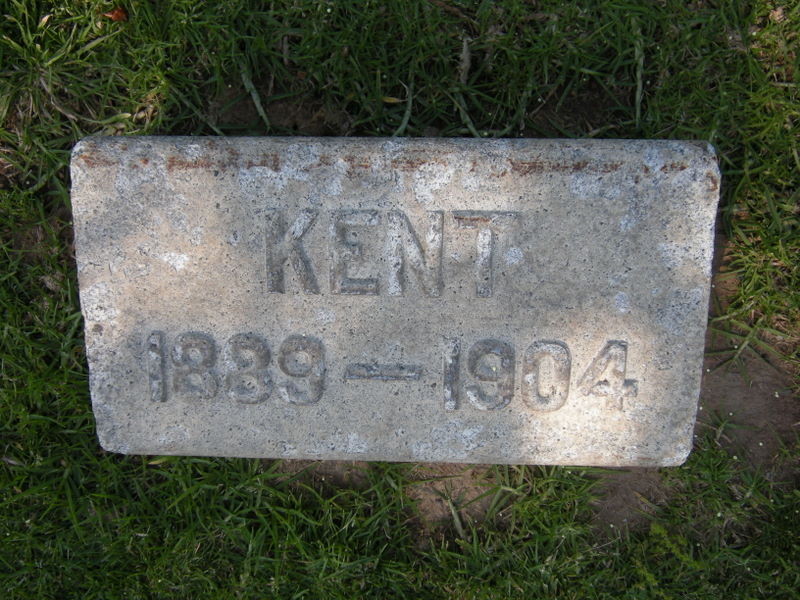
Harry Chandler died on September 23, 1944 from a heart attack. He and Marian are buried at Hollywood Forever Cemetery on Santa Monica Boulevard. Harrison Gray Otis's memorial is nearby.
Chandler Boulevard, a major street in the San Fernando Valley, is named for Harry Chandler.

City Politics
Chandler used the influence of his newspaper in efforts to sway political decisions, with mixed success. In 1949, Chandler attempted to use his influence with the Los Angeles Police Department to ensure that Thad Brown was named the next chief of police. His efforts were foiled, however, when a commissioner thought to be under Chandler's control died shortly before the vote. Instead, William Parker was selected.[2]

Sources
1.^ Gosney, E.S. (1929). Twenty-eight Years of Sterilization in California. Pasadena, California: The Human Betterment Foundation. p. 38.
2.^ Buntin, John (2009). L.A. Noir. New York: Harmony Books. pp. 419. ISBN 978-0-307-35207-1.

Further reading
The Powers That Be, David Halberstam, Dell Books, 1986
Privileged Son: Otis Chandler and the Rise and Fall of the L.A. Times Dynasty, Dennis McDougal, Perseus Publishing, 2001
The Ancestry of Harry Chandler by Gwendolyn Garland Babcock

Subscribe to:
Posts (Atom)